
WELCOME BONUS 300%
UP TO €2000 + 100
FREE SPINS
UP TO €2000 + 100
FREE SPINS
Home → Blackjack
Blackjack at Best Casino: Variants, Rules and Payouts
RNG draws cards from virtual eight-deck shoe
The RNG engine utilizes a virtual eight-deck shoe to determine card distribution, establishing the baseline for game integrity. This specific configuration influences the house edge, which stands at 0.46% for standard Blackjack 6 Decks variants where the dealer stands on Soft 17. Players relying on basic strategy face this mathematical reality, as the eight-deck setup slightly increases the casino's advantage compared to single-deck alternatives.
Comparing the eight-deck model to a single-deck game reveals a significant shift in player odds, with the latter offering a lower house edge of 0.15%. The additional decks increase the probability of drawing specific cards, thereby altering the expected return to player percentage across thousands of hands. This structural difference means that players seeking the lowest theoretical cost should carefully evaluate deck counts before committing their bankroll to any table.
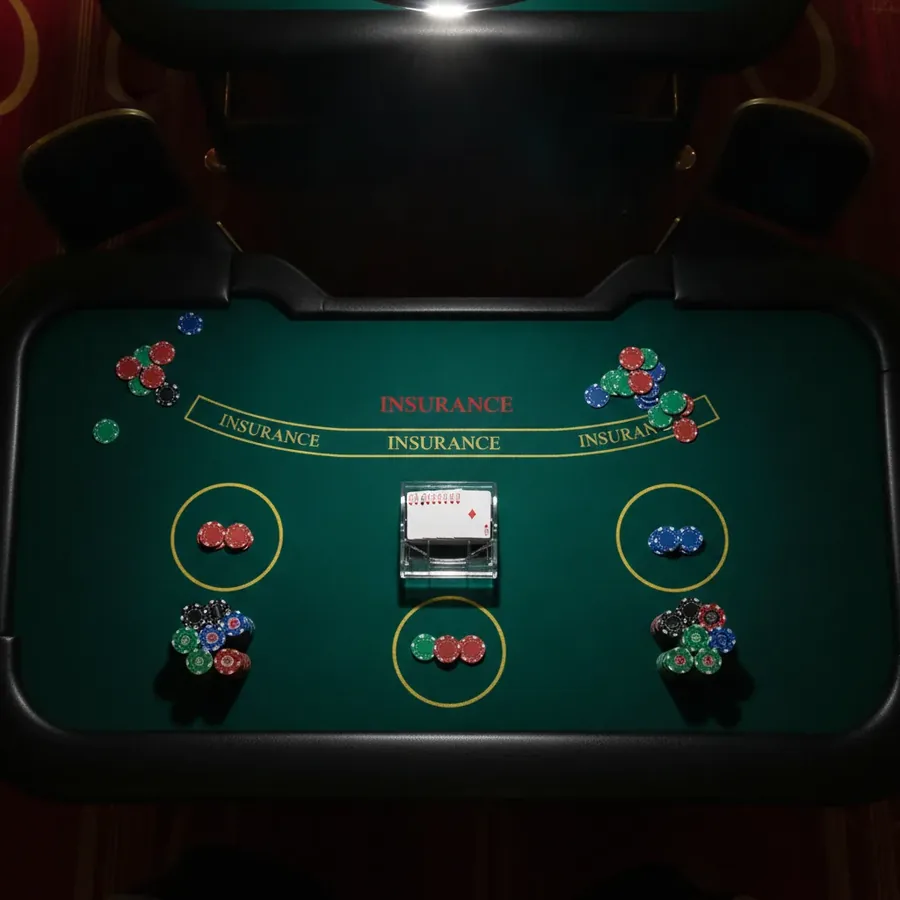
Insurance bets present a separate risk profile within these multi-deck games, carrying a steep house edge of 7.47% and an RTP of only 92.53%. This side bet is mathematically unfavorable for most players, requiring a true count of +3 or higher to become profitable through card counting strategies. Avoiding insurance preserves the base game RTP, ensuring that the initial 99.54% expectation remains intact rather than being eroded by high-cost supplementary wagers.
Double Down after Split: which tables allow it
The Double After Split rule significantly improves player odds by allowing re-doubling on split hands, contributing a 0.14 percentage point reduction to the house edge. This feature is available in Liberal Vegas Strip variants, which offer one of the most favorable rule combinations including late surrender and resplitting capabilities. Utilizing DAS correctly can lower the overall house edge to 0.28%, making it a critical factor for strategic decision-making during gameplay sessions.
In contrast, tables without Double After Split maintain a higher house edge, losing approximately 0.14 percentage points of value for the player compared to those permitting it. Standard Blackjack 6 Decks rules typically restrict doubling to the initial two cards, preventing players from maximizing profits on strong split hands like Aces or eights. Recognizing this limitation helps players avoid tables where the mathematical advantage remains firmly with the casino due to restrictive doubling policies.
Resplitting Aces provides an additional 0.08 percentage point benefit, further enhancing the profitability of liberal rule sets found in Evolution's Lightning Blackjack. This table allows unlimited players and offers multipliers up to 25x, but the underlying blackjack rules still dictate the fundamental win rate regardless of bonus features. Combining DAS with resplitting options creates a synergistic effect that minimizes the house edge, offering better long-term returns for disciplined strategists playing live dealer games.
Side Bets don't count towards bonus turnover
Side bets such as insurance are explicitly excluded from contributing to bonus turnover requirements, which stand at a standard contribution rate of 10% for table games. Since insurance carries a house edge of 7.47%, using it to meet wagering targets is financially inefficient compared to playing main game hands. Players must ensure their betting patterns align with terms, as only the primary wager volume counts toward the necessary turnover for withdrawal eligibility.
The welcome bonus offers 300% up to €2,000 plus free spins, requiring significant turnover completion before funds become withdrawable. Because table games contribute only 10% to this requirement, a €100 bet generates just €10 of progress, drastically extending the time needed to clear conditions. Slot machines contribute 100%, making them far more efficient for meeting wagering demands, while side bets provide zero progress toward unlocking the bonus capital entirely.
Quantum Blackjack Plus Live features multipliers up to 1,000x on three-card combinations, but these exciting side bet outcomes do not accelerate bonus clearance. The RTP of 99.57% applies to the main game strategy, yet the side bet payouts remain isolated from the wagering calculation framework. Players chasing the bonus must focus on base game hands, as relying on high-variance side bets will neither improve their odds nor help satisfy the financial thresholds set by the promotion terms.
Blackjack doesn't count for every bonus offer
The 300% welcome bonus up to €2,000 includes specific game restrictions where table games contribute only 10% to the wagering requirement. This low contribution rate means that playing Blackjack variants like Quantum Blackjack Plus Live requires ten times more volume compared to slots to unlock the same bonus amount. Players must calculate the total turnover needed based on the 10% contribution to avoid depleting their balance before meeting the promotional criteria.
Different bonus offers may exclude table games entirely, rendering Blackjack contributions ineffective for certain promotions. While the current data highlights the 10% contribution for general table games, specific no-deposit or free spin bonuses often have stricter exclusions. Understanding these variations is crucial, as assuming all bonuses treat Blackjack equally can lead to unexpected forfeiture of winnings when wagering conditions are not fully satisfied through eligible game types.
Lightning Blackjack by Evolution allows bets between 1 EUR and 2,500 EUR, but the high limits do not bypass the 10% contribution rule for bonus turnover. A maximum bet of 2,500 EUR contributes only 250 EUR toward the wagering target per hand, necessitating careful bankroll management during bonus play. Players should verify if their chosen bonus excludes live dealer games entirely, as some offers restrict table game participation to protect the casino's margin against high-stakes strategy usage.
Double Down vs Simple Hit on 11
Double Down on 11 is the optimal mathematical play against a dealer's weak upcard, potentially increasing the bet by 100% to maximize expected value. This action leverages the high probability of drawing a ten-value card, turning a simple hit into a more aggressive profit-seeking maneuver. Deviating from this strategy by simply hitting reduces the long-term return, as doubling captures additional value from favorable deck compositions during the hand resolution process.
The house edge of 0.46% for standard Blackjack assumes perfect strategy execution, including correct doubling decisions on hard 11 against dealer upcards 2 through 10. Hitting instead of doubling ignores the statistical advantage provided by the double-down mechanic, effectively increasing the casino's hold on the player's bankroll over time. Maintaining discipline in these specific scenarios ensures that the theoretical RTP of 99.54% remains achievable rather than being eroded by suboptimal tactical choices.
Liberal Vegas Strip rules enhance the profitability of doubling by allowing resplitting and late surrender, which collectively reduce the house edge to 0.28%. These favorable conditions make aggressive doubling strategies even more rewarding, as the reduced house advantage compounds with each successful double down outcome. Players utilizing these liberal rule sets should prioritize doubling on 11 to exploit the lower variance and improved odds inherent in the specific game variant's structure.
Blackjack variants at a glance
| Variant | Payout | House edge | Rule | Bet range |
|---|---|---|---|---|
| Blackjack Ein Deck, klassische Regeln, 3:2 | 99.85% | 0.15% | Weniger Decks = niedrigerer Vorteil; ein Deck gibt ca. −0.48 Prozentpunkte gegenüber 8 Decks. Oft durch 6:5 Auszahlung kompensiert. | Blackjack 3:2, Gewinn 1:1 |
| Blackjack Liberal Vegas Strip (liberale Regeln, 3:2) | 99.72% | 0.28% | Günstigste Regelkombination: S17 + DAS + Resplit + Late Surrender. Standardabweichung 1,15 | Blackjack 3:2, Gewinn 1:1 |
| Blackjack 6 Decks, S17, DAS, DOA, Auszahlung 3:2, Basisstrategie | 99.54% | 0.46% | Dealer steht auf Soft 17; Verdopplung auf jeder Zweierkarte; Verdopplung nach Split erlaubt; keine Aufgabe. Basisstrategie ist für diesen Wert zwingend | Blackjack 3:2, normaler Gewinn 1:1, Insurance 2:1 |
| Blackjack Auszahlung 6:5 statt 3:2 (6 Decks) | 98.15% | 1.85% | Ersatz von 3:2 durch 6:5 fügt exakt +1.39 Prozentpunkte zum Vorteil des Casinos hinzu – stärker als jede andere Regeländerung. Bei $10 Einsatz zahlt Blackjack $12 statt $15. | Blackjack 6:5, Gewinn 1:1 |
| Blackjack Split / Double / H17 – Regel-Effekte | n.a. (Regel-Modifikatoren) | H17 +0.22 Prozentpunkte; RSA −0.08 Prozentpunkte; DAS −0.14 Prozentpunkte | Dealer Hits Soft 17 verschlechtert RTP um 0.22 Prozentpunkte; Resplit Aces verbessert um 0.08 Prozentpunkte; Double After Split verbessert um ca. 0.14 Prozentpunkte; 6 Decks statt 8 – ca. 0.02 Prozentpunkte. | Double – Einsatz ×2 mit einer Karte; Split – bis 4 Hände; Ass-Split meist mit einer Karte. |
| Blackjack Insurance / Versicherung (6–8 Decks) | 92.53% | 7.47% | Separate Nebenwette bis 50% der Hauptwette, wenn der Dealer ein Ass hat. Basisstrategie schreibt IMMER Ablehnung vor (außer Karten zählen bei True Count ≥ +3). Bei einem Deck Vorteil ≈ 5.88% | Insurance 2:1 |
Continuous Shuffling Machine shuffles after each round
A Continuous Shuffling Machine (CSM) reshuffles the deck immediately following every completed hand in live dealer environments. This mechanical process eliminates the need for manual intervention by dealers between rounds, ensuring a consistent flow of gameplay. The constant agitation of cards prevents any form of card counting strategy from gaining an edge over the house. Players relying on memory-based tactics will find their methods rendered ineffective by this technological barrier.
The presence of a CSM typically increases the casino's house edge by approximately one percent compared to games using physical shoe shoes. This mathematical disadvantage arises because the shuffled composition resets constantly, denying players the ability to track high-value card depletion. For instance, standard Blackjack with eight decks offers a 0.46% house edge, while CSM variants often push this figure higher. The statistical variance remains stable, but the long-term expected loss for the player increases significantly due to this rule change.
Players must adjust their bankroll management strategies to account for the accelerated pace and increased house advantage inherent in these tables. A session lasting two hours at a $10 minimum bet could result in a substantially larger deficit than in traditional shoe games. The rapid turnover means more hands are played per hour, compounding the effect of the elevated house edge over time. Consequently, strategic depth is reduced, making outcome reliance purely on luck rather than skillful decision-making.
What Hole Card Means at a Live Table
In traditional land-based casinos, the dealer receives one face-up card and one face-down hole card during the initial deal. However, modern live dealer platforms like Evolution and Playtech have largely eliminated the physical hole card to prevent delays and cheating risks. Instead, they utilize electronic sensors or camera systems that reveal the hole card only after all player decisions are finalized. This technological shift ensures immediate transparency regarding the dealer's final hand value without interrupting the game flow.
The absence of a visible hole card alters the strategic implications of certain rules, such as Late Surrender, which is still available in some variants. When the dealer checks for blackjack before players act, the risk of losing the entire bet on a dealer natural is removed early. For example, Surrender allows players to forfeit half their bet if the dealer has a strong starting position, improving RTP by 0.08%. This rule becomes particularly valuable when combined with favorable table conditions like Dealer Standing on Soft 17.
Players should note that the removal of the hole card does not change the fundamental probabilities of the game itself, provided the rules remain standard. The House Edge for a typical six-deck game with S17 and DAS remains around 0.46%, regardless of how the hole card is handled. However, the psychological experience changes as players cannot peek at the dealer's potential strength before committing fully to a hand. Understanding this mechanic helps manage expectations regarding information availability during critical decision points.
Blackjack Party runs with two hosts
Blackjack Party by Evolution features a unique format hosted by two charismatic presenters who interact with players throughout the session. This dual-host setup creates a lively atmosphere distinct from standard single-dealer tables, often incorporating music and entertainment elements. The betting limits for this specific variant range from 1.00 EUR to 1,000 EUR, accommodating both casual players and high rollers. The interactive nature aims to enhance engagement beyond pure gameplay mechanics.
While the thematic presentation differs, the underlying mathematics of Blackjack Party align closely with standard European Blackjack rules. The Return to Player (RTP) is generally competitive, though specific percentages depend heavily on the rule set employed by the provider. Players should verify if the table offers 3:2 payouts for natural blackjacks, as 6:5 variants drastically reduce returns to an RTP of 98.15%. The host interaction does not influence the RNG or card distribution algorithms governing the outcome.
The social aspect introduced by two hosts may appeal to players seeking a more dynamic environment than solitary online play. However, the core strategic requirements remain identical to other live blackjack tables, demanding knowledge of basic strategy charts. With a base house edge of roughly 0.46% under optimal rules, players can still minimize losses through disciplined play. The entertainment value adds a layer of enjoyment without altering the fundamental economic expectations of the game.
Error insurance: 7 percent additional house edge
Insurance is a side bet offered when the dealer shows an Ace, paying 2:1 if the dealer has a natural blackjack. This wager carries a significant house edge of 7.47%, making it one of the least favorable bets in the casino. Statistical analysis confirms that taking insurance reduces the overall RTP of the game unless the player is employing advanced card counting techniques. For the average player adhering to basic strategy, declining insurance is always the mathematically superior choice.
The cost of insurance can be quantified by comparing its return against the main game's performance metrics. While the main blackjack hand might offer an RTP near 99.54%, adding insurance drags the combined expectation down sharply. If a player bets 10 EUR on the main hand and 5 EUR on insurance, the total exposure increases while the expected loss grows disproportionately. Over thousands of hands, this habitual error results in substantial financial erosion compared to skipping the side bet entirely.
Card counters may occasionally take insurance when the true count reaches +3 or higher, where the odds shift in their favor. However, this exception applies only to skilled players tracking deck composition, not to casual participants using fixed strategy charts. For the vast majority, the 7.47% house edge on insurance represents a guaranteed negative expectancy over the long term. Avoiding this trap preserves the integrity of the primary game's theoretical return and protects the player's bankroll from unnecessary depletion.
Check table limit before the first bet
Table limits define the minimum and maximum wager sizes allowed at any given live dealer blackjack table. For instance, Quantum Blackjack Plus Live by Playtech accepts bets ranging from 1 EUR to 5,000 EUR, catering to high-stakes enthusiasts. In contrast, Lightning Blackjack by Evolution restricts wagers to a maximum of 2,500 EUR, limiting the scale of potential wins per round. These boundaries ensure the casino manages its risk exposure while providing options for various budget levels.
Understanding these limits is crucial for effective bankroll management and avoiding disqualification from winning large pots. Exceeding the maximum stake often results in the bet being voided or capped, leading to lost opportunities on winning hands. Players aiming to utilize progressive betting systems must carefully select tables where the upper limit accommodates their progression steps. A mismatch between strategy and table constraints can abruptly terminate a successful streak due to arbitrary operational restrictions.
The disparity between minimum and maximum limits also influences the variety of strategies applicable to each specific table. Low-limit tables like those in Blackjack Party (1-1,000 EUR) are suitable for conservative players testing new tactics. High-limit venues allow for aggressive capital deployment but require stricter discipline to withstand volatility. Always verifying the current limits before seating ensures alignment between financial resources and the game's structural parameters, preventing costly administrative errors.
Early Surrender is removed from many tables
The removal of Early Surrender significantly increases the house edge compared to Late Surrender, which improves RTP by approximately 0.08 percentage points. This rule modification forces players to forfeit half their stake only after the dealer checks for blackjack, whereas Early Surrender allows surrender before this check and reduces the house advantage by up to 0.6 percentage points. Consequently, the absence of Early Surrender at most live dealer venues makes it harder to mitigate losses on weak hands like a hard 16 against a dealer 10.
Most modern live dealer platforms exclusively offer Late Surrender or remove the option entirely to protect the casino's mathematical advantage. The specific value of Late Surrender is limited to reducing the house edge by roughly 0.08 percentage points, which is far less impactful than other rule variations like resplitting aces. Players relying on surrender strategies will find their bankroll erosion accelerated because they cannot exit losing positions as early as historical rules permitted in land-based environments.
The distinction between surrender types directly affects the theoretical return, with Early Surrender being the superior mechanic for player retention of funds. Since Early Surrender can lower the house edge by up to 0.6 percentage points, its exclusion represents a substantial increase in expected loss per hand over thousands of iterations. Analysts recommend avoiding tables that omit both surrender options to minimize the structural disadvantage imposed by the game design itself.
Blackjack Contributes Only 10 Percent to Wagering
The 300 percent welcome bonus up to €2,000 plus 100 free spins requires significant turnover, yet Blackjack contributes only 10 percent toward wagering requirements. This means that for every €100 wagered on table games, only €10 counts toward clearing the bonus conditions, drastically extending the time needed to unlock withdrawal rights. Slot machines contribute 100 percent, making them the efficient choice for bonus conversion, while table games like Quantum Blackjack Plus Live become inefficient vehicles for meeting these targets.
Playing Evolution Lightning Blackjack with stakes between 1 and 2,500 EUR generates turnover slowly under these contribution rules. A €1,000 total bet on this title adds merely €100 to the wagering progress, requiring ten times the volume compared to playing high-contribution slots. This structure effectively penalizes skilled players who prefer low-house-edge games, forcing them to either play slots with higher variance or accept much longer lock-up periods for their deposited funds.
The disparity in contribution rates favors the operator by ensuring that players engage with games possessing higher inherent house edges during the bonus phase. While Quantum Blackjack Plus Live offers an RTP of 99.57 percent, the 10 percent contribution rate neutralizes the strategic advantage by inflating the effective cost of gameplay relative to bonus clearance. Players must calculate the total required turnover based on the 10 percent metric to avoid depleting their bankroll before satisfying the casino's terms.
Ignored Basic Strategy Chart: 1 Percent Wasted
Deviating from the optimal basic strategy chart can waste approximately one percent of the expected return, turning a near-even game into a negative expectation scenario. For instance, playing Blackjack 6 Decks with S17 and DAS yields a house edge of just 0.46 percent when strategy is perfect, but errors easily push this above one percent. Each incorrect decision, such as standing on 16 against a dealer 10, accumulates losses that compound rapidly over hundreds of hands dealt at live tables.
The insurance bet illustrates the cost of ignoring statistical advice, carrying a house edge of 7.47 percent versus the main game's minimal margin. Taking insurance when the true count is not at least +3 violates basic strategy, which dictates always declining this side bet unless counting cards. At Quantum Blackjack Plus Live, where multipliers apply, failing to follow base strategy undermines the potential gains from the game's unique features, leading to suboptimal long-term returns.
Strict adherence to the provided strategy charts is essential for minimizing the house edge across all variants, including those with liberal rules like Vegas Strip. Even with a low house edge of 0.28 percent in Liberal Vegas Strip, any deviation increases the casino's advantage, eroding the player's bankroll faster than intended. Consistent application of correct decisions ensures that the theoretical RTP remains achievable, preventing unnecessary financial drain due to emotional or intuitive play errors.
Bet two percent of bankroll per hand
Betting two percent of your total bankroll per hand provides a buffer against the natural variance inherent in blackjack sessions. With Quantum Blackjack Plus Live allowing bets from 1 to 5,000 EUR, a €1,000 bankroll would require a €20 stake to maintain this discipline. This approach prevents rapid depletion during losing streaks, as even a ten-hand loss only reduces the bankroll by approximately twenty percent rather than wiping it out entirely.
The volatility of live dealer games necessitates strict bankroll management to survive the inevitable downswings without going bust. By capping wagers at two percent, players ensure they have sufficient funds to weather fluctuations in the RTP of 99.57 percent observed in Playtech titles. This method aligns with professional risk management principles, allowing extended playtime and more opportunities to capitalize on favorable outcomes within the constraints of the table limits.
Exceeding this two percent threshold significantly increases the risk of ruin, especially when facing the house edge variations found in different rule sets. For example, playing Blackjack with a 6:5 payout instead of 3:2 increases the house edge to 1.85 percent, demanding even stricter betting controls to preserve capital. Maintaining a consistent bet size relative to the current bankroll helps stabilize losses and keeps the gaming experience sustainable over longer sessions.
Why Loss Progression Quickly Reaches Table Limit
Loss progression systems, such as doubling bets after each defeat, quickly escalate stakes until they hit the maximum table limit imposed by the provider. In Evolution's Lightning Blackjack, the maximum bet is capped at 2,500 EUR, meaning a standard progression sequence starting at 1 EUR will reach this ceiling after just eleven consecutive losses. Once the limit is reached, the player cannot double the stake to recover previous losses, rendering the strategy ineffective and resulting in substantial financial damage.
The mathematical inevitability of hitting table limits exposes the flaw in progressive betting methods, regardless of the game's underlying RTP. Even with a favorable RTP of 99.56 percent in Lightning Blackjack, the variance of short-term results ensures that losing streaks occur regularly enough to trigger these caps. When the maximum bet of 2,500 EUR is reached, the player loses the ability to mitigate losses, locking in a deficit that cannot be recovered through further betting adjustments.
Table limits act as a hard boundary for progression strategies, preventing infinite recovery attempts and guaranteeing that the house edge eventually prevails. For instance, if a player starts with a €1 bet and doubles after each loss, reaching the €2,500 limit occurs rapidly during typical variance swings. This structural constraint ensures that no betting system can overcome the casino's advantage, as the finite bankroll and table caps prevent the necessary exposure to positive expectation scenarios.
Contact
Live - online chat
Banking









Providers











Best Casino 2026